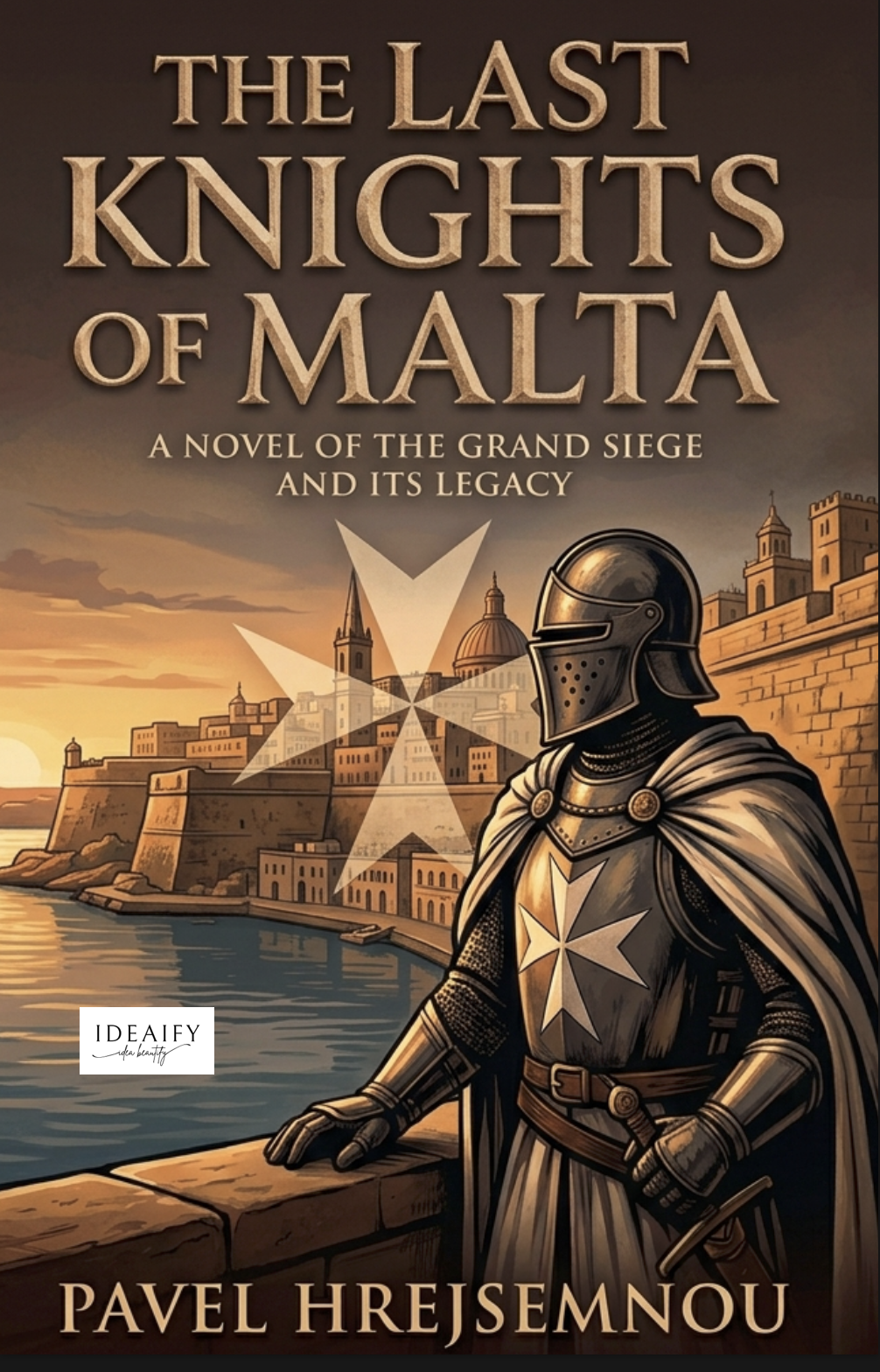
1565. The Mediterranean holds its breath.
When the Ottoman Empire launches one of history’s most massive invasions against the tiny island of Malta, two men find themselves on opposite sides of an epic struggle that will determine the fate of Christendom.
Marcus, a Knight of St. John, stands ready to defend every inch of the crumbling fortress walls. Hasan, an ambitious Ottoman commander, is determined to prove his worth to the Sultan. As the siege tightens its deadly grip, both warriors discover that honor, survival, and victory come at a terrible price.
Through four months of relentless combat, secret intrigues, and impossible choices, this gripping historical epic brings to life one of history’s most dramatic confrontations. From the blood-soaked ramparts of Fort St. Elmo to the narrow streets of Birgu, witness a story where courage clashes with duty, and where the line between hero and enemy blurs in the smoke of battle.
The Great Siege of Malta. One island. Two warriors. No mercy.
He wrote: Pavel Hrejsemnou
Published by: IDEAIFY s.r.o. 2026
- A5 format – 245 pages
- PDF – ISBN – 978-80-88523-31-4
- ePuB – ISBN – 978-80-88523-32-1
299 Kč
When Empires Collide: The Story Behind “The Siege of Malta 1565”
By Pavel Hrejsemnou
The Day History Held Its Breath
There are moments in history when the fate of civilizations hangs by a thread. When the decisions of a few determine the destiny of many. When courage and cruelty dance together in the smoke of battle, and when ordinary men are called to do extraordinary things.
The Great Siege of Malta in 1565 was such a moment.
For nearly four months, a tiny island in the heart of the Mediterranean became the stage for one of history’s most brutal and consequential conflicts. The Ottoman Empire, at the height of its power, threw everything it had against the Knights Hospitaller—a religious military order that stood as the last Christian bulwark between the Muslim east and the European west.
This is the story I set out to tell. Not just the story of armies and strategies, of dates and casualty figures, but the story of people. Of men who woke up each morning not knowing if they would live to see the sunset. Of warriors who discovered that honor and survival are often bitter enemies. Of two soldiers, on opposite sides of a wall, who came to understand that the greatest battles are fought not just with swords, but within the human soul.
Why Malta? Why 1565?
I first encountered the Great Siege as a young student, flipping through a dusty history book that devoted exactly three pages to those four months of fighting. Three pages. That was all. Yet within those pages, I found something that haunted me: the account of Fort St. Elmo, where 1,500 defenders held out for over a month against an army of tens of thousands, knowing they had no chance of survival.
They fought anyway.
Why? What drives a man to stand on a crumbling wall, facing impossible odds, when retreat might mean life and resistance means almost certain death?
That question became the seed from which this novel grew.
Malta in 1565 was more than just a strategic outpost. It was a symbol. For the Ottomans, capturing it would open the door to Sicily, to Italy, perhaps even to Rome itself. For the Knights Hospitaller, losing it would mean the end of their order, the end of their centuries-long mission to defend Christendom.
But symbols don’t bleed. Men do.
I wanted to write about those men. About the Maltese farmer who picked up a pike even though he’d never fought before. About the young knight who had trained his whole life for this moment and now found that nothing could prepare him for the reality of combat. About the Ottoman soldier who had traveled thousands of miles, following his commander’s orders, wondering if he would ever see his homeland again.
Creating Marcus and Hasan
The historical record gives us names like Jean de La Valette, Mustafa Pasha, Turgut Reis—great leaders whose decisions shaped the course of the siege. But history is rarely made by leaders alone. It’s made by the thousands of unnamed individuals who carry out those decisions, who fight and die and sometimes, against all odds, survive.
That’s why I created Marcus and Hasan.
Marcus is a Knight of St. John, but he’s not the stereotypical hero. He’s tired. He’s afraid. He’s watched too many friends die. Yet when the moment comes, he stands. Not because he’s fearless, but because he understands that sometimes the only choice is between dying with honor or living with shame.
Hasan is his mirror image on the Ottoman side. He’s ambitious, yes, but he’s also thoughtful. He respects his enemy even as he tries to destroy them. He begins to question whether victory is worth the price, even as he’s compelled to pay it.
Through their eyes, I wanted to show that war is not a simple matter of good versus evil. Both sides believed they were right. Both sides committed acts of courage and cruelty. Both sides lost men they loved.
When Marcus and Hasan finally meet face-to-face in the chaos of battle, it’s not just a clash of swords. It’s a collision of two worlds, two faiths, two visions of honor. And in that moment, they both realize something terrible and beautiful: they are more alike than they are different.
The Weight of Historical Truth
Writing historical fiction is a balancing act. On one side, there’s the responsibility to honor the facts—to get the dates right, to describe the fortifications accurately, to portray the strategies as they actually unfolded. On the other side, there’s the need to tell a compelling story, to create characters readers care about, to find the human truth within the historical record.
I spent months researching the Great Siege. I studied contemporary accounts by Francisco Balbi di Correggio, the chronicler who lived through the siege. I examined maps from the period, walked the streets of modern Valletta, visited the ruins of Fort St. Elmo. I read military histories, theological treatises, personal letters.
But the most important research happened in the quiet moments, when I tried to imagine what it must have felt like to be there.
To stand on those walls as the Ottoman cannons roared. To smell the smoke and blood and burning pitch. To hear the screams of wounded men and the prayers of the dying. To know that every sunrise might be your last.
That’s what I wanted to capture. Not just the what of history, but the how. How did these people endure? How did they find the strength to keep fighting when all hope seemed lost? How did they reconcile their faith with the horror surrounding them?
The Siege’s Echo in Our Time
The Great Siege of Malta ended on September 8, 1565, when the Ottoman forces, battered and demoralized, finally withdrew. The defenders had won. But victory came at a terrible cost. Of the approximately 6,000 defenders who began the siege, only about 4,000 remained. The Ottomans lost perhaps 20,000 men.
In the aftermath, Europe breathed a sigh of relief. The Ottoman advance into the western Mediterranean had been halted. Malta became a symbol of Christian resistance, and the new city of Valletta rose from the ruins as a testament to human determination.
But the siege’s significance goes beyond military strategy or religious conflict. It reminds us of something fundamental about the human condition: that we are capable of both unimaginable cruelty and extraordinary courage. That ordinary people, when faced with extraordinary circumstances, can rise to meet the moment.
In our own time, when the world faces new conflicts, new divisions, new tests of our collective will, I think there’s value in remembering Malta 1565. Not to glorify war, but to understand what people are capable of when they believe in something deeply enough to fight for it.
Marcus and Hasan are fictional, but their struggles are real. The questions they face—about duty, honor, faith, and survival—are questions we all face, in different forms, in our own lives.
A Final Word
This book is dedicated to the memory of all those who fought and died during the Great Siege, on both sides. They were not just soldiers or statistics. They were sons, brothers, fathers, friends. They had hopes and dreams and fears. They loved and lost and, in the end, they gave everything.
History remembers the victors. But stories remember the human beings.
May we never forget either.
Pavel Hrejsemnou is a writer of historical fiction with a passion for bringing forgotten moments of history to vivid life. When not researching battles and sieges, they can be found exploring the Mediterranean, searching for the places where history happened.
BOOK NEWS

You can also find all books at these booksellers: