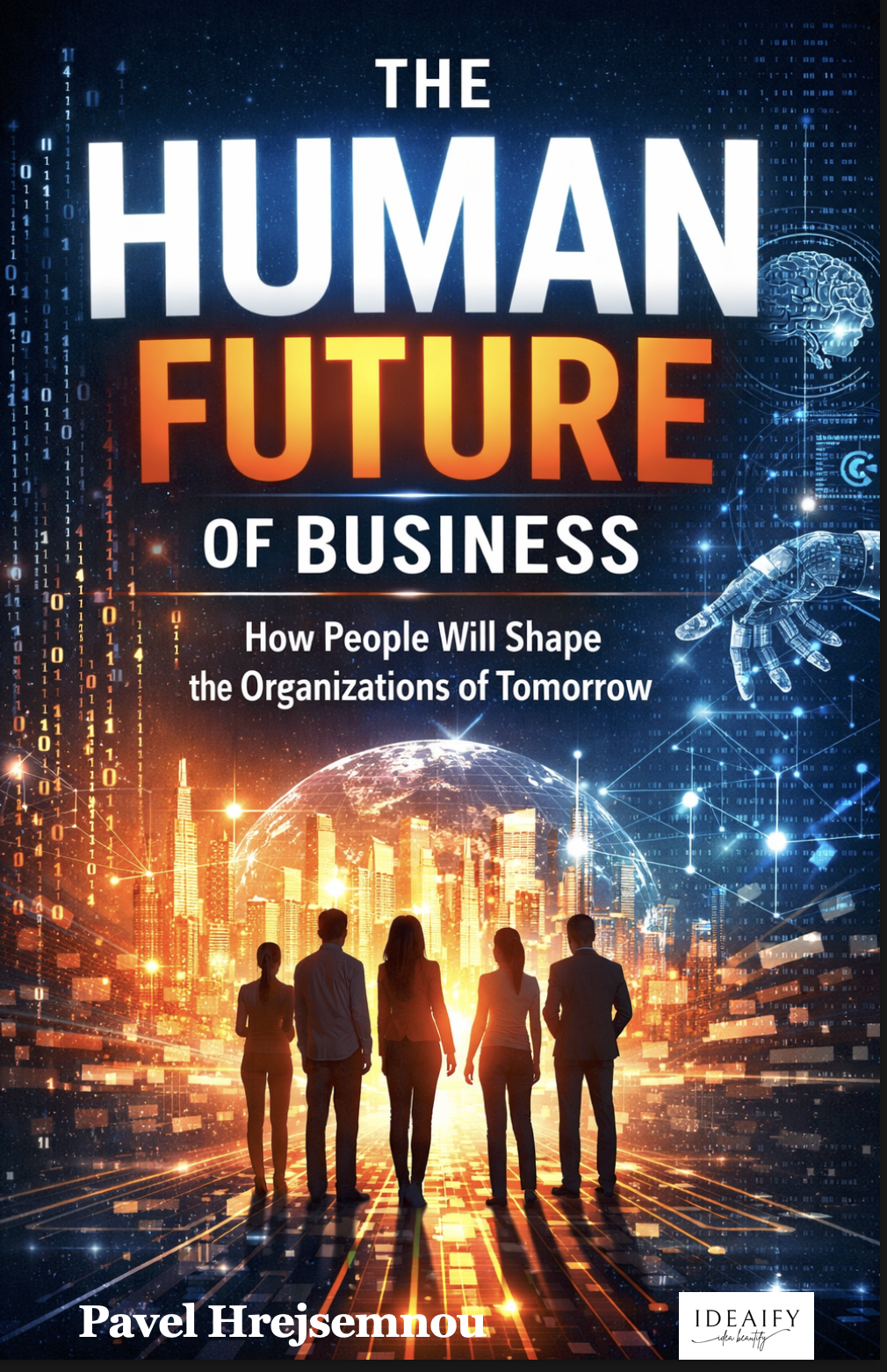
The Human Future of Business explores one of the most important questions of the 21st century: What will organizations look like when people become their greatest strategic advantage?
In a world shaped by artificial intelligence, digital transformation, and global competition, businesses are being forced to rethink the foundations of leadership, talent management, and organizational culture. Traditional hierarchies are dissolving, new forms of collaboration are emerging, and employees increasingly seek purpose, autonomy, and meaningful work.
This book offers a comprehensive exploration of how modern organizations can adapt to these profound changes.
Across nearly one thousand pages, it examines the transformation of leadership, the evolution of human resources into a strategic function, and the growing importance of culture, trust, and human creativity in the workplace.
The Human Future of Business provides a deep and structured analysis of key themes shaping the organizations of tomorrow:
• the rise of human-centered leadership
• the transformation of talent management
• the strategic role of organizational culture
• the future of recruitment and global talent markets
• the impact of artificial intelligence on work
• leadership development in complex environments
• the evolution of HR into a strategic leadership function
• the integration of technology and human potential
Rather than presenting a rigid management formula, the book invites readers to rethink the relationship between people, leadership, and organizational performance.
It demonstrates that the most successful organizations of the future will not be those that rely solely on technology or scale, but those that unlock the full potential of human creativity, collaboration, and purpose.
Written for leaders, entrepreneurs, HR professionals, and anyone interested in the future of work, The Human Future of Business offers both a strategic perspective and a human vision of organizations in the twenty-first century.
He wrote: Pavel Hrejsemnou
Published by: IDEAIFY s.r.o. 2026
- A5 format – 971 pages
- PDF format – Electronic version of the book – ISBN 978-80-88523-27-7
- ePub format – Electronic version of the book – ISBN 978-80-88523-28-4
349 Kč
Why Read This Book
Why The Human Future of Business Matters Today
The world of work is undergoing one of the most significant transformations in modern history.
Artificial intelligence, digital technologies, globalization, and demographic shifts are fundamentally changing how organizations operate. Jobs that once defined entire industries are disappearing, new professions are emerging, and traditional organizational structures are being replaced by more flexible and adaptive systems.
In the midst of these changes, many leaders are asking the same question:
What will successful organizations look like in the future?
This book was written to explore that question in depth.
The Transformation of Work
For much of the twentieth century, organizations were built around efficiency and control. Large hierarchies dominated industries, decision-making authority was concentrated at the top, and employees were expected to follow clearly defined roles within structured systems.
This model worked well in an industrial economy where stability and scale were the primary drivers of success.
Today, however, the environment is radically different.
Technological innovation moves faster than ever before. Information flows instantly across continents. Talent can work from virtually anywhere in the world.
Organizations must therefore become more adaptive, more innovative, and more human-centered.
The Rise of Human-Centered Leadership
One of the central ideas explored in this book is that the future of business will increasingly depend on human capability.
Technology will continue to transform industries, but it will not replace the uniquely human qualities that drive innovation and progress: creativity, curiosity, ethical judgment, empathy, and the ability to collaborate.
Organizations that understand this reality will design systems that empower people rather than control them.
Leadership in such organizations is no longer defined by authority alone. It is defined by the ability to inspire, guide, and develop others.
The Strategic Role of Talent
Another major theme of this book is the transformation of talent management.
In the past, human resources departments were often seen primarily as administrative units responsible for recruitment, payroll, and compliance.
Today, however, talent has become one of the most important strategic assets of any organization.
Companies compete not only through technology or capital but through the knowledge, creativity, and engagement of their people.
As a result, HR leaders are increasingly becoming strategic partners in shaping the future of organizations.
Organizations as Living Systems
Modern organizations are beginning to resemble living systems rather than rigid machines.
They learn, adapt, evolve, and respond to changing environments.
Successful organizations encourage continuous learning, open communication, and collaboration across departments and disciplines.
They also understand the importance of culture.
A healthy organizational culture fosters trust, psychological safety, and the willingness to experiment with new ideas.
The Human Future of Business
Ultimately, this book argues that the future of business is not merely technological.
It is fundamentally human.
Technology will continue to reshape industries, but organizations will succeed only if they learn how to harness human potential more effectively.
This means creating workplaces where people can grow, contribute, and find meaning in their work.
It means developing leaders who see themselves not only as managers of performance but as stewards of human potential.
And it means recognizing that the most powerful resource any organization possesses is not technology, capital, or infrastructure.
It is the people who bring those systems to life.
A Book for Leaders of the Future
The Human Future of Business is written for leaders, entrepreneurs, HR professionals, and anyone interested in the evolving nature of organizations.
It does not promise quick fixes or simplistic management formulas.
Instead, it offers a thoughtful exploration of the ideas shaping the future of work and leadership.
For readers willing to reflect on these ideas, the book provides a framework for understanding how organizations can thrive in an increasingly complex and human-centered world.